Commercial or Home Grade? Why the Cheap Option Costs More
A home-grade machine is a reasonable product bought for the wrong room. Here is what actually differs, and the three cases where home grade is the right answer.
The distinction between home and commercial equipment is not marketing. It is a difference in duty cycle, and duty cycle is what wears a machine out.
A home machine might see three sessions a week by two people, in a room kept at room temperature, with a user who weighs 75 kg and is careful with the equipment. A commercial machine on a health club floor sees forty to eighty sessions a day, seven days a week, by users ranging from 45 kg to 160 kg, at 06:00 and at 21:00, in a room with humidity and constant cleaning.
That is roughly a hundredfold difference in cycles. Components sized for one workload will not survive the other, no matter how similar the two machines look in a photograph.
- Tube and wall thickness. Commercial frames use heavier gauge steel, and more importantly they are gusseted at high-load junctions. A home machine is usually fine at the joint until it is not.
- Bearings instead of bushes. Pressed bronze or plastic bushes work at low cycle counts and develop play quickly at high ones. Sealed bearings cost more and last longer.
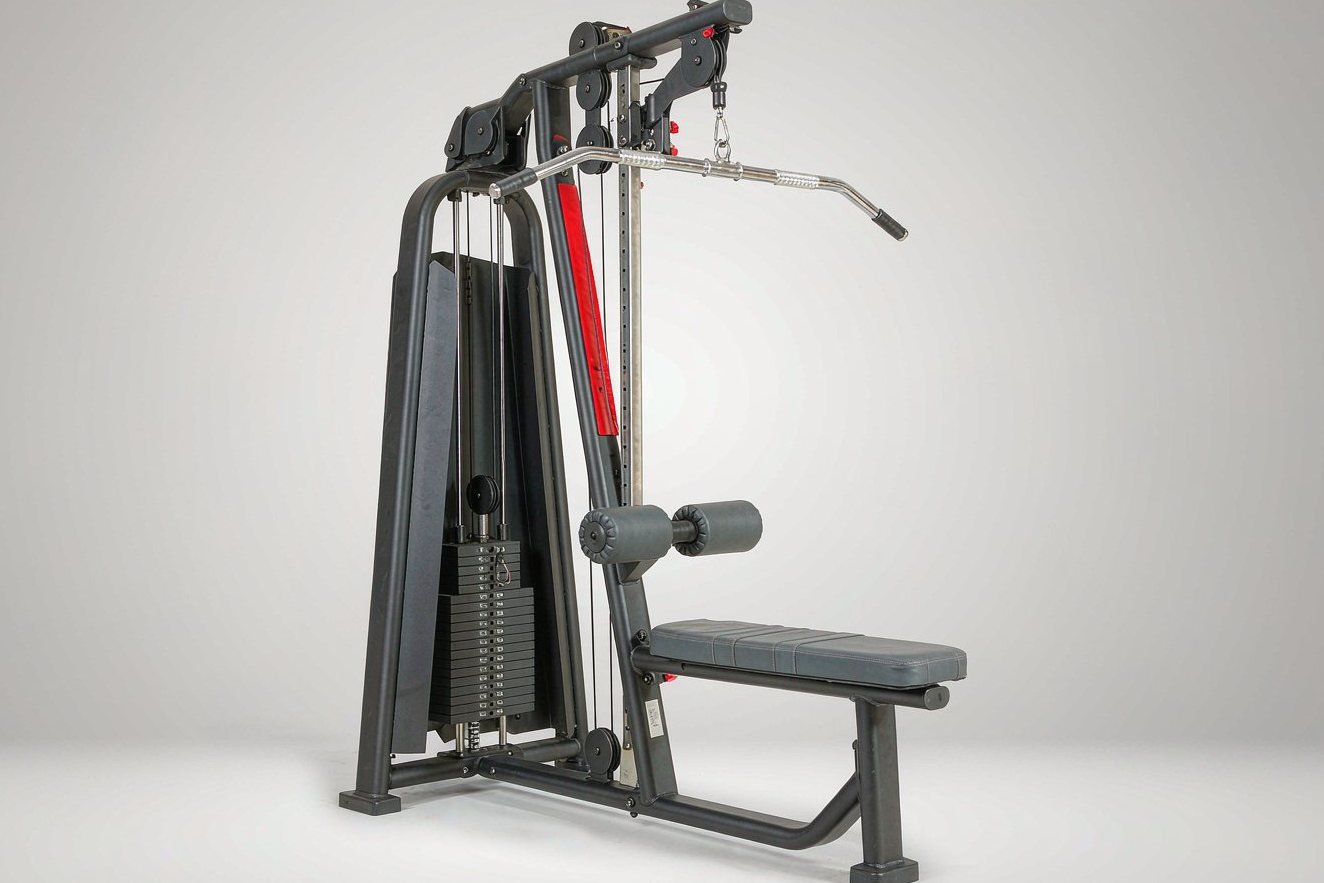
- Cable and pulley specification. A commercial cable is 6 × 19 with a higher breaking load, running on a machined aluminium pulley with a sealed bearing. Home machines often use a lighter cable over a small plastic pulley.
- Upholstery. Commercial pads are denser, thicker and sewn with a different seam pattern, and in our case they unbolt individually so a worn pad is a part rather than a machine.
- Weight stack increments and shrouds. Commercial machines need fine increments for a wide range of members, and shrouds because stacks are a hand and finger hazard on a public floor.
- Serviceability and spares. The commercial question is not whether it breaks but whether the part is available in three years.
Read the warranty in terms of hours, not years. A two-year home warranty on a machine used three hours a day is a shorter commitment than a one-year warranty on equipment designed for continuous use. Ask what is covered on frames, cables, upholstery and electronics separately — those four categories age at different rates, and a warranty that treats them as one number is usually written to exclude the expensive one.
Three cases: a private residence where the machine will genuinely be used by one or two people; a very small office wellness room with fewer than twenty regular users; and a seasonal property used four months a year. In each of those, a well-made light-commercial machine is a sensible purchase, and we will say so rather than upselling into a commercial frame that will never see a busy hour.
What we would not do is put light-commercial equipment on a public floor and describe it as commercial. The failure mode is not a machine that stops working — it is a machine that becomes slightly loose, slightly noisy and slightly unpleasant, and members notice long before the maintenance log does.
Need commercial gym equipment?
Talk to our sales team — send quantities, destination and branding requirements and we will price it properly.