Choosing Commercial Cardio: Why Self-Powered Beats Motors More Often Than You Think
Motorised treadmills carry installation, energy and service costs that rarely appear in the purchase price. A cost comparison over five years.
Cardio equipment is the largest low-yield investment on most gym floors. It occupies floor area, consumes power, requires dedicated circuits and generates a service call every time a control board or drive belt fails. For many facilities, that arithmetic now favours self-powered equipment.
A motorised treadmill carries costs that do not appear in the unit price:
- Electrical installation. Dedicated circuits, and often 220 V or 380 V provision depending on the model. The wiring, breakers and distribution can be a meaningful capital item.
- Energy. A commercial treadmill running eight hours a day draws in the region of 1.5 to 2.5 kW under load. Across a floor of ten machines, that is a real annual line item.
- Service. Drive boards, motors, belts, deck lubrication and control consoles. Most manufactures will not publish a five-year service cost, because the number is uncomfortable.
- Downtime. A motorised machine that fails is unusable until a part arrives. On a self-powered machine, the failure modes are largely mechanical and repairable locally.
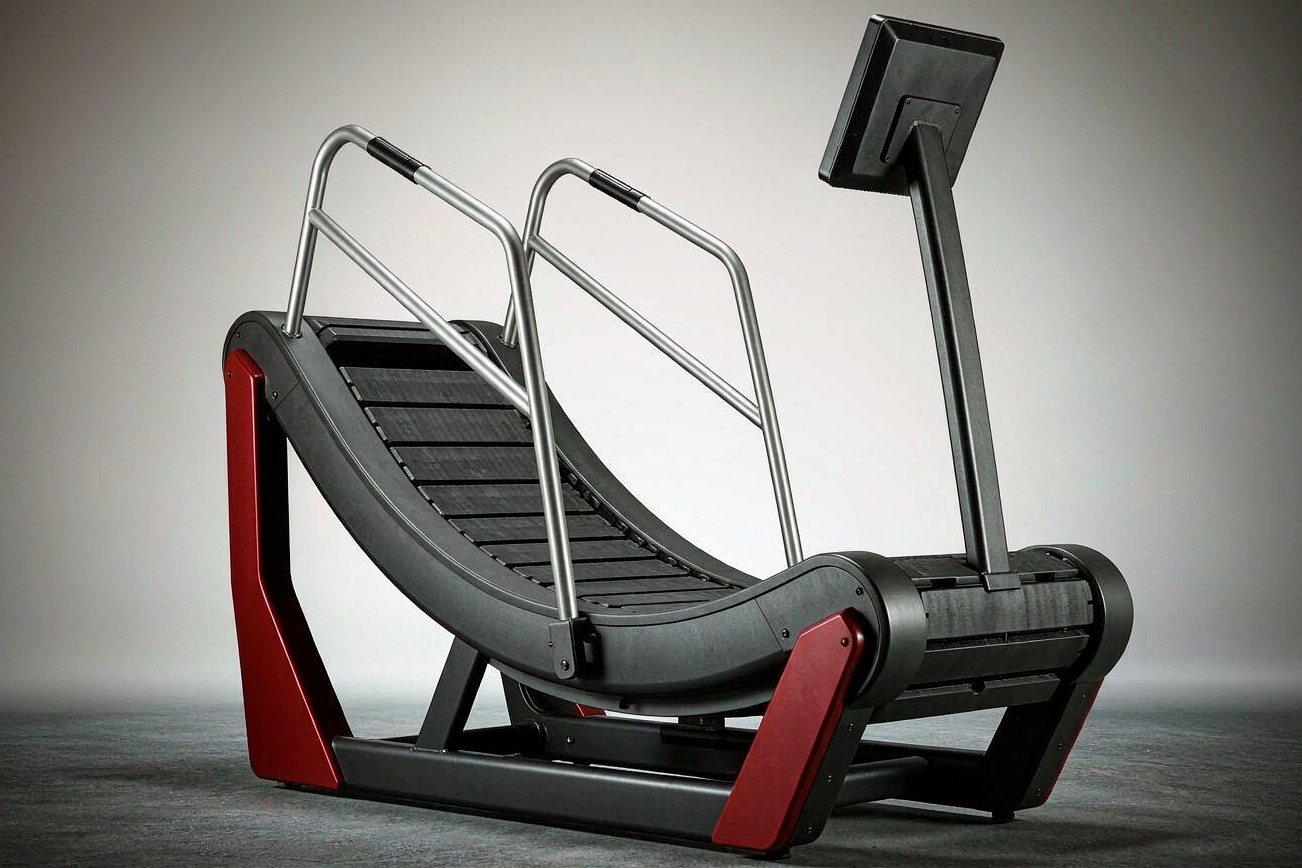
A curved treadmill has no motor. The runner drives the belt, so there is no control board, no drive motor and no power supply to install. The failure points reduce to the belt, the bearings and the frame — all serviceable and all cheap relative to a drive assembly.
The curve itself is not cosmetic. It places the running surface so the drive point sits slightly ahead of the contact point, which encourages a mid-foot strike and makes the machine useful for sprint and conditioning work as well as steady walking. It is harder for a casual user than a flat motorised belt, and that is worth knowing before you replace an entire cardio line.
Be honest about the trade-offs. Motorised treadmills remain better for:
- Incline programming and pace-controlled interval work
- Older or deconditioned members who need a flat, predictable surface
- Facilities with medical or rehabilitation programmes requiring exact speed prescription
- Users who want a screen and entertainment options
If your membership skews towards walkers, casual users or clinical referrals, keep a mix. If it skews towards training members, athletes or a 24-hour facility with no on-site technician, self-powered equipment is usually the better long-term decision.
For a ten-machine cardio line, the purchase price difference between motorised and self-powered equipment is often modest. The divergence comes later: electrical installation, energy consumption, service parts and downtime usually widen the gap significantly in favour of self-powered equipment — and the units remain usable throughout.
For a commercial club, we usually suggest a mixed cardio offer: two or three motorised treadmills for members who specifically want them, the balance self-powered, plus magnetic cycles rather than friction-pad bikes for the same reason — no wear surfaces, no adjustment, and far quieter in a shared building.
Ask us for the five-year cost breakdown on any cardio specification we quote. We will put the service items in it, whether or not they favour the product we are selling.
Need commercial gym equipment?
Talk to our sales team — send quantities, destination and branding requirements and we will price it properly.